

A national packaging compliance brief

The producer's
field guide
to EPR.

A new generation of state laws is making producers, not municipalities, accountable for the packaging they put into the market. Seven states have now passed binding programs, and the obligations follow the product across state lines, regardless of where it was packaged or shipped from.

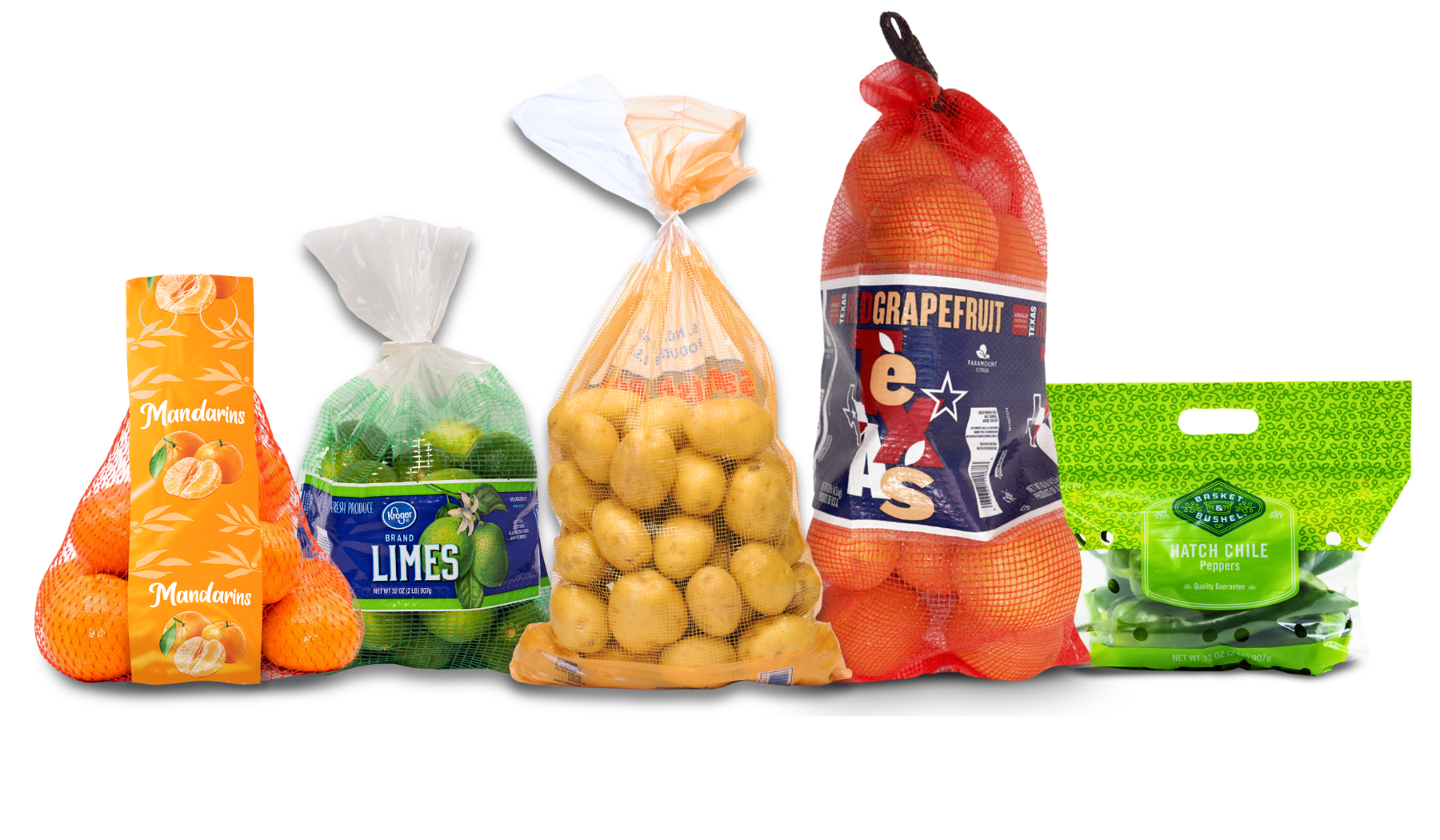
Flexible food packaging on the production floor

Extended Producer Responsibility (EPR) is a packaging law framework that makes the producer of a packaged good responsible for the cost of collecting, sorting, and recycling that packaging after the consumer is done with it.

In a state with EPR, producers register with a state-approved program, report what packaging they put into the market, and pay fees that fund the recycling system. Fees are set by material type, so packaging that is easier to recycle costs less.

For decades, packaging recovery has been the responsibility of local governments and taxpayers. EPR moves that responsibility to the producer. Under an EPR program, the company that sells packaged goods into a regulated state is responsible for funding the collection, sorting, and recycling of that packaging.

This shift is now law in California, Oregon, Colorado, Minnesota, Maryland, Maine, and Washington. The laws cover packaging systems and paper products broadly, and in some states extend to food serviceware. Flexible packaging is in scope, and tends to draw the highest fee tiers because flexibles are the format the recycling system handles least well.

This guide covers three things: what the model is, where it is in effect, and what it means for producers and brands selling into regulated states.

How EPR Works

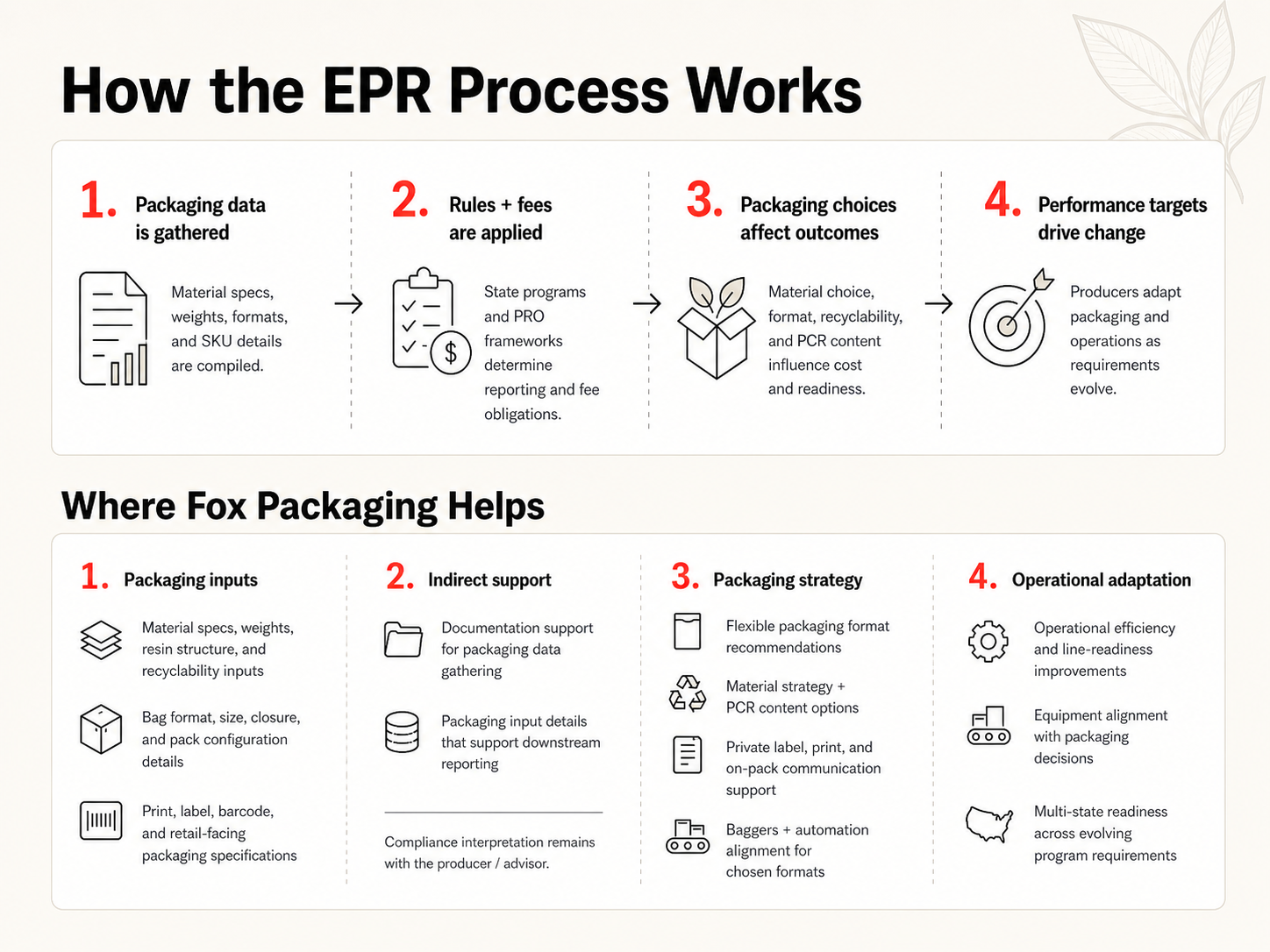
Across every enacted state, the program follows the same four steps: register, report, pay, design. The details vary by state; the structure does not.

01
REGISTER

Producer joins a PRO.

Companies above a revenue or volume threshold register with a Producer Responsibility Organization, the state-approved entity that runs the program.

02
REPORT

Disclose materials and tonnage.

Producers report packaging by material, weight, and recyclability category, SKU by SKU. Underreporting carries penalty risk; misclassification carries audit risk.

03
PAY

Fees are eco-modulated.

Each material gets a per-pound rate. Hard-to-recycle structures (multi-layer laminates, mixed films) pay more; mono-material and certified-recyclable formats pay less.

04
DESIGN

Re-design closes the loop.

Producers respond by redesigning packaging to qualify for lower-fee tiers, converting laminates to mono-PE, simplifying inks, removing problem additives.

FRONT OF LOOP  
DATA OBLIGATION  
FINANCIAL OBLIGATION  
DESIGN RESPONSE  

Every EPR program rewards recyclability. Easier-to-recycle packaging costs less in fees. Mono-material flexibles pay materially less per pound than traditional laminates, by design.

39%
of packaging materials in the U.S. are currently recovered for recycling.
$36.5-43.4B
estimated investment required to modernize the U.S. recycling system.
18-20%
of U.S. households have access to composting that can process packaging materials.

Where EPR applies today.

Each state runs its own producer responsibility organization, its own thresholds, and its own definition of recyclable. Producers selling into multiple states report into multiple programs.

Enacted · binding program Drafting · legislation in progress
Maine
Enacted
First state to pass packaging EPR (2021). Implementation through state stewardship organization.
Oregon
Enacted · Reporting Active
First U.S. program in active reporting (2025). Eco-modulated fees in effect.
Colorado
Enacted · Dues Active
Producer dues began 2026. Registration through Circular Action Alliance.
California
Enacted
SB 54. Source reduction, recyclability, and recycling-rate targets through 2032.
Minnesota
Enacted
Statewide producer responsibility law passed 2024. Implementation milestones underway.
Maryland
Enacted
Producer-funded program enacted 2025. Registration framework in development.
Washington
Enacted
Statewide packaging EPR law enacted 2025. Aligns broadly with OR/CO frameworks.
New York
Drafting
Packaging Reduction and Recycling Infrastructure Act. Active in legislature.
New Jersey
Drafting
Packaging Product Stewardship Act. Bill in committee.
Illinois
Drafting
Producer responsibility legislation introduced. Under review.
Massachusetts
Drafting
Packaging EPR bill active in legislature.
Connecticut
Drafting
Packaging EPR legislation introduced.
Rhode Island
Drafting
Packaging stewardship bill in legislature.
Vermont
Drafting
Packaging EPR legislation under consideration.
Tennessee
Drafting
Producer responsibility legislation introduced.
+ More underway
Nationwide Pipeline
15+ additional states have introduced or studied packaging EPR bills since 2023, including Hawaii, Virginia, North Carolina, and Michigan. Industry trackers expect convergence on California-style frameworks as the regulated footprint expands each session.
Implementation Timeline

Key milestones, 2025-2032.

2025

Oregon launches

First U.S. EPR program enters reporting. Producers register through Circular Action Alliance.

2026

Colorado dues begin

Colorado producer dues active. Maryland and Washington programs advancing.

2027-28

Reporting expands

Multi-state producers running parallel reports. Fee schedules public in additional states.

2029-30

Mid-window milestones

Minnesota phased obligations advance. Drafting states enact and converge on framework patterns.

2032

California targets land

SB 54's recyclable / compostable, source-reduction, and recycling-rate targets all come due.

A practical packaging partner for a multi-state regulatory landscape.

EPR reshapes how packaged goods reach the market. Fox helps producers, distributors, and food and produce brands think through formats, materials, supplier documentation, print and labeling, and equipment readiness as their products cross regulated state lines.

Diagram: How the EPR Process Works and Where Fox Packaging Helps

Seven places this touches your operation.

Some of these are direct legal obligations. Others are practical business impacts that follow from how the rules reshape procurement, design, and operations. Both belong on your plan.

i.

Packaging fees / material-based costs

Direct line item in covered states. Eco-modulated by material; producers running multi-layer flexibles pay more per pound than mono-material equivalents. Magnitude depends on tonnage and structure mix.

TypeLegal obligation
ii.

Material reformulation

Mono-material polyethylene replaces traditional laminates where performance allows. Tooling, sealing, and shelf-life testing all move with it. Engineering and sample cycles add 6-12 months.

TypePractical impact
iii.

SKU-level reporting

Material composition, weight, and recyclability tracked per SKU, per state. Most ERPs don't carry this data natively, producers stand up new reporting workflows or use third parties.

TypeLegal obligation
iv.

Supplier documentation

Recyclability claims must be substantiated. Producers will require supplier documentation, certifications, test data, structure breakdowns, that wasn't routine in the pre-EPR market.

TypePractical impact
v.

Print and labeling review

Heavy ink coverage and certain pigment systems can disqualify packaging from recyclable-tier rates. Brand and print teams re-spec to keep the lower fee tier and meet labeling rules.

TypePractical impact
vi.

Inventory and changeover planning

Reformulated structures mean parallel SKUs through the transition window. Inventory, labels, and case codes move alongside film changes, planning matters as much as design.

TypePractical impact
vii.

Multi-state compliance oversight

Each state defines “recyclable” differently. A producer selling into seven states files seven reports against seven definitions, the same case of pouches reads differently in each.

TypeLegal obligation
Printed flexible film on the press
A note from Fox · advisory, not pitched

You can prepare for this before the deadline forces it.

We work with producers and brands selling into Oregon, California, and the rest of the regulated states. The conversations that go best start a year or two before the reporting clock, while there's still time to test mono-material substitutes, validate seal performance on existing equipment, and stage inventory through the changeover.

If you're 18 months out, that's a comfortable window. If you're six months out, it's tight but workable. If you're past the deadline and reporting against assumptions, that's the conversation we should be having today.

Fox Packaging · National Packaging & Equipment Partner
END / GUIDANCE Talk to a national packaging partner

Know where your packaging stands before the deadline does.

Send your current structures and the states you sell into. We'll come back with a read on packaging options, supplier documentation needs, and operational readiness across the regulated states, in plain numbers.

Fox Packaging can help evaluate packaging options and operational readiness; specific compliance obligations should be reviewed with legal or regulatory counsel.