EPR update | November 2026

What you
need to know
about EPR now.

New state laws are making producers, not local governments, responsible for the packaging they sell. Seven states have now passed binding programs, and the requirements follow your product into every state where it’s sold.

Extended Producer Responsibility (EPR) is a packaging law framework that makes the producer of a packaged good responsible for the cost of collecting, sorting, and recycling that packaging after the consumer is done with it.

In a state with EPR, producers register with a state-approved program, report what packaging they put into the market, and pay fees that fund the recycling system. Fees are set by material type, so packaging that is easier to recycle costs less.

As of November 2026, seven states have enacted packaging EPR laws: California, Colorado, Maine, Maryland, Minnesota, Oregon and Washington. Flexible packaging is generally in scope. Registration, reporting and fee schedules differ by state. In California, EPR fees begin in January 2027, and Circular Action Alliance has published its 2027 fee schedule. CalRecycle also updated the state’s SB 54 source reduction baseline on November 2, 2026, using producer-reported 2023 data.

Depending on the state, producers may need to report:

    • Packaging material and resin
    • Package weight
    • Gauge
    • Components and structure
    • Number of plastic components
    • PCR content
    • Packaging quantities by state
    • Brand and responsible producer
    • Recyclability information
    • Historical packaging data

    Circular Action Alliance notes that producer reporting generally includes packaging weights and quantities of covered materials supplied into a state. California also requires reporting the weight and number of plastic components for source reduction.

    If Fox Packaging manufactures your package, ask us for your packaging data. Our sustainability team maintains material specifications, weights, and technical information for the bags we make, and can help with package composition, material structures, packaging assessments, artwork, and recyclability labeling questions.
How EPR Works

Across every enacted state, the program follows the same four steps: register, report, pay, design. The details vary by state; the structure does not.

01
REGISTER

Producer joins a PRO.

Companies above a revenue or volume threshold register with a Producer Responsibility Organization, the state-approved entity that runs the program.

02
REPORT

Disclose materials and tonnage.

Producers report packaging by material, weight, and recyclability category, SKU by SKU. Accurate reporting starts with reliable packaging data.

03
PAY

Fees are eco-modulated.

Each material gets a per-pound rate. Hard-to-recycle structures (multi-layer laminates, mixed films) pay more; mono-material and certified-recyclable formats pay less.

04
DESIGN

Re-design closes the loop.

Producers respond by redesigning packaging to qualify for lower-fee tiers, converting laminates to mono-PE, simplifying inks, removing problem additives.

FRONT OF LOOP  →
DATA OBLIGATION  →
FINANCIAL OBLIGATION  →
DESIGN RESPONSE  ↻

Source reduction and recycled content are two of the strongest levers producers have. Here’s where Fox already stands:

~20%
reduction in PE mesh weight on applicable Fox packaging, with functional performance maintained.
Up to 30%
PCR content available in qualifying Fox polyethylene film applications.
Since 2008
Fox has recycled post-industrial plastic from manufacturing through Valley Plastics & Paper Recycling.

Where EPR applies today.

Each state runs its own producer responsibility organization, its own thresholds, and its own definition of recyclable.

Enacted · binding program Drafting · legislation in progress
Maine
Enacted
First state to pass packaging EPR (2021). Implementation through a state stewardship organization.
Oregon
Enacted · Reporting active
First U.S. program in active reporting (2025). Eco-modulated fees in effect.
Colorado
Enacted · dues active
Producer dues began in 2026. Registration through Circular Action Alliance.
California
Enacted · fees begin 2027
SB 54. Fees begin January 2027. Source reduction baseline updated November 2026.
Minnesota
Enacted
Statewide producer responsibility law passed in 2024. Implementation milestones underway.
Maryland
Enacted
Producer-funded program enacted in 2025. Registration framework in development.
Washington
Enacted
Statewide packaging EPR law enacted in 2025. Aligns broadly with OR and CO frameworks.
New Jersey
Drafting · bill pending
Packaging Product Stewardship Act. Bill carries over into 2027.
Virginia
Drafting · bill pending
Packaging EPR bill carries over into 2027.
New York
Drafting · expected 2027
Packaging Reduction and Recycling Infrastructure Act. Expected to be reintroduced in 2027.
Massachusetts
Drafting · expected 2027
Packaging EPR bill advanced in 2025–26. Expected to be reintroduced in 2027.
Illinois
Drafting · needs assessment
Prior bill did not pass. Statewide needs assessment underway.
Rhode Island
Drafting · needs assessment
Statewide needs assessment underway to shape a future EPR program.
Tennessee
Drafting · expected 2027
Packaging EPR bill introduced in 2025. Expected to be reintroduced.
+ More underway
Nationwide Pipeline
15+ additional states have introduced or studied packaging EPR bills since 2023, including Hawaii, North Carolina, and Michigan. Status as of November 2026. Laws change each session, so check current status before relying on it.
Implementation Timeline

Key milestones, 2025-2032.

2025

Oregon launches.

First U.S. EPR program enters reporting. Producers register through Circular Action Alliance.

2026

Colorado dues begin.

Colorado producer dues active. Maryland and Washington programs advancing.

2027-28

California fees begin.

CA fees start January 2027, with a 10% source reduction target. Multi-state producers run parallel reports.

2029-30

Targets step up.

California’s source reduction target rises to 20% by 2030. Minnesota phased obligations advance.

2032

California final targets.

25% source reduction, a 65% plastic recycling rate, and all covered packaging recyclable or compostable.

A practical packaging partner for a multi-state regulatory landscape.

For packaging Fox manufactures, we can help with material composition, gauge, package weight, PCR content, technical specifications, APR testing documentation where applicable, our PFAS statement, packaging optimization reviews, and artwork and labeling support.

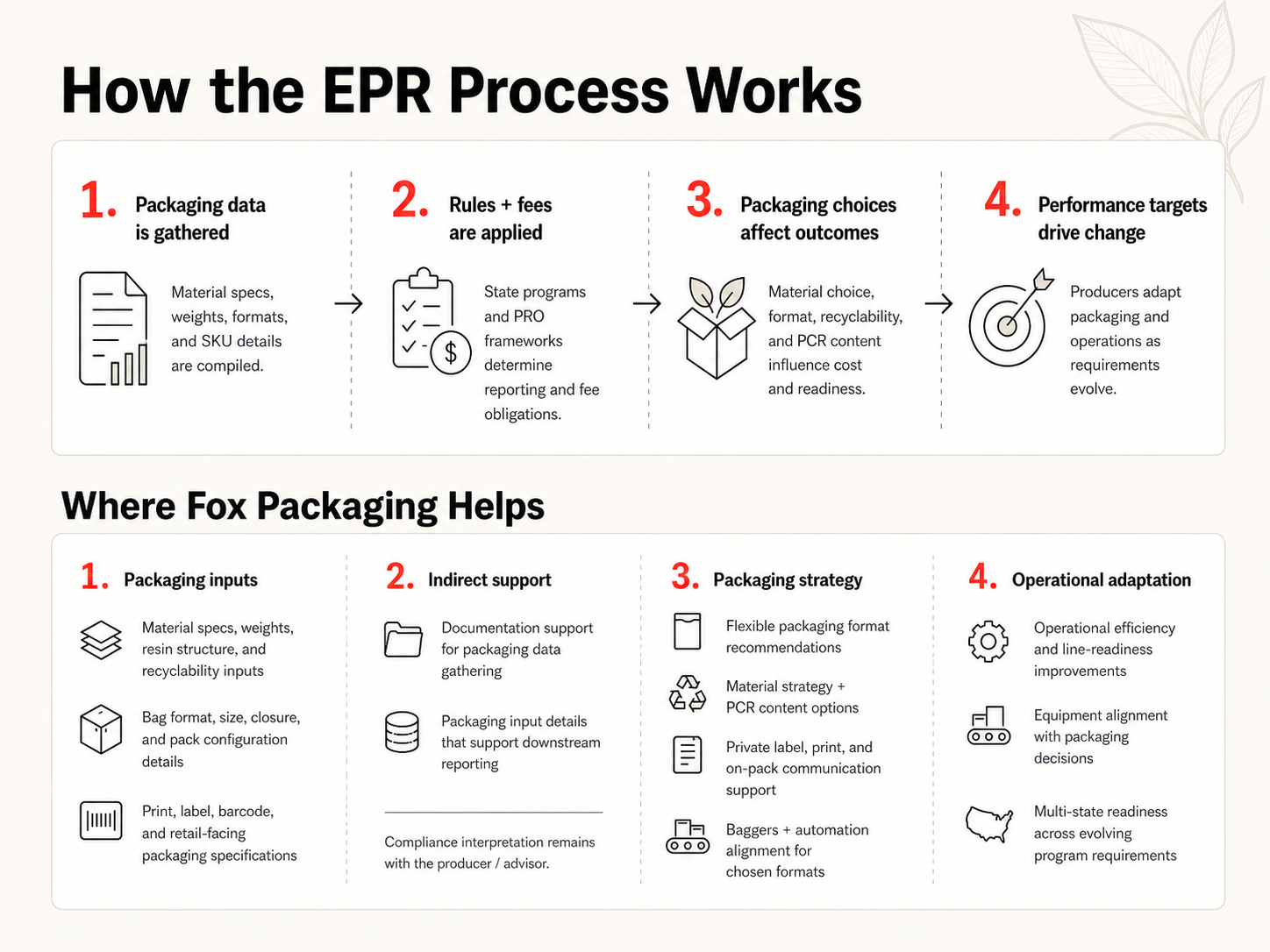
Diagram: How the EPR Process Works and Where Fox Packaging Helps

Seven places this touches your operation.

Some of these are direct legal obligations. Others are practical business impacts that follow from how the rules reshape procurement, design, and operations. Both belong on your plan.

i

Packaging fees / material-based costs

Direct line item in covered states. Eco-modulated by material; producers running multi-layer flexibles pay more per pound than mono-material equivalents. Magnitude depends on tonnage and structure mix.

TypeLegal obligation
ii

Material reformulation

Lightweighting, downgauging and recycled content are all source reduction options, but any change needs testing on your product and line. Fox can help you review what’s realistic for your package.

TypePractical impact
iii

SKU-level reporting

Material, weight, gauge, PCR content and number of plastic components may be tracked per SKU, per state. Many companies are building new workflows to collect it.

TypeLegal obligation
iv

Supplier documentation

Recyclability claims need support. Fox maintains technical recyclability documentation for applicable structures, including APR testing where available. Ask us for product-specific documentation.

TypePractical impact
v

Print and labeling review

EPR and recyclability labeling are not the same thing. SB 54 covers producer responsibility, reporting and fees. SB 343 covers recyclability claims on labels, and its enforcement is currently paused by a federal court injunction.

TypePractical impact
vi

Inventory and changeover planning

Reformulated structures mean parallel SKUs through the transition window. Inventory, labels, and case codes move alongside film changes, planning matters as much as design.

TypePractical impact
vii

Multi-state compliance oversight

Producers selling into multiple states may report into multiple programs, each with its own definitions and deadlines.

TypeLegal obligation
Printed flexible film on the press
A note from Fox.

Start with the package.

The best EPR conversations start early, while there’s time to review your current packaging, test options on your line, and plan any changes. We’ve been reducing material and offering recycled-content options well before EPR made it a requirement, and we continue to evaluate compostable and alternative materials.

Fox Packaging · McAllen, Texas.
Talk to our team.

EPR starts with understanding your packaging.

Tell us which states you sell into and what packaging you use, and we’ll help you find the data and options available for your bags.

Fox Packaging provides packaging and technical information but does not provide legal advice. Customers remain responsible for determining how applicable laws and regulations affect their products and operations.